
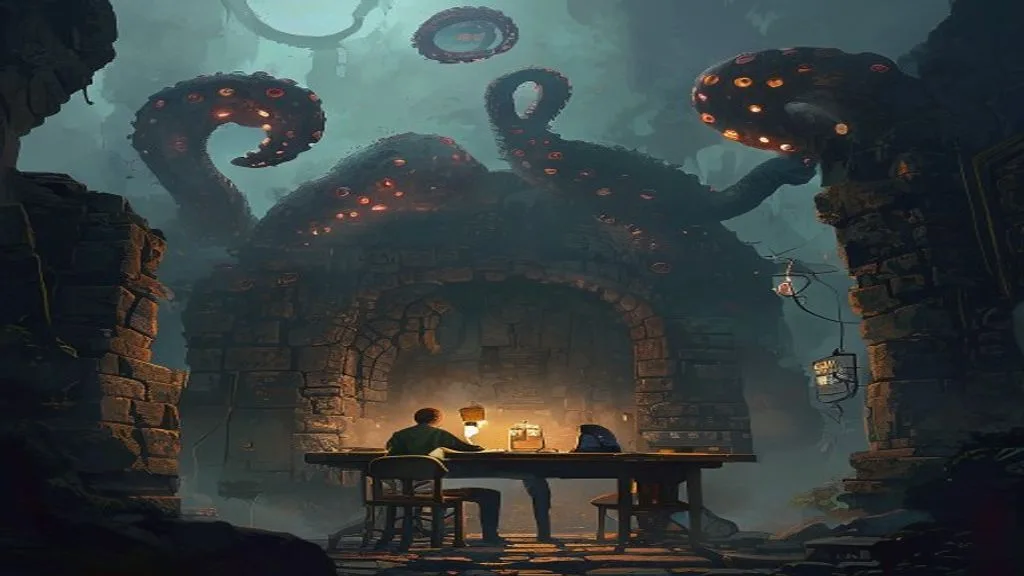
So there you are, 2 AM, the room’s dark, headphones cranked up, and something with too many tentacles just crawled out of the fog in your game. Your heart’s pounding. You love it. You hate it. You can’t stop playing.
That’s the magic of Lovecraftian survival games — and if you’ve already burned through Dread and you’re hungry for more, pull up a chair. I’ve been down this rabbit hole (more like a bottomless eldritch pit, honestly) and I’ve got some thoughts on where to go next, how to pick the right game for your taste, and how to actually survive these nightmares without rage-quitting at 3 AM.
Step 1: Figure Out What You Actually Liked About Dread
This sounds obvious. It’s not. Dread does a bunch of things at once — atmosphere, resource scarcity, sanity mechanics, cosmic horror lore — and different players latch onto different pieces. Before you start downloading everything tagged “Lovecraftian” on Steam, ask yourself: was it the tension? The storytelling? The feeling of being genuinely underpowered against something you couldn’t comprehend?
Because here’s the thing. Some games nail the atmosphere but fumble the survival loop. Others have fantastic crafting and resource management but dress it up with generic monster designs that feel more B-movie than Lovecraft. You want both? That narrows things down fast.
Personally, I’m a sucker for the sanity mechanic side of things — that slow psychological unraveling where the game starts messing with you, not just your character. If a game doesn’t make me second-guess what I’m seeing on screen, it’s not doing enough.
Baca juga: First Person Psychological Horror Games yang Bikin Kamu Nanya "Kenapa Gue Main Ini Jam 2 Pagi?
Step 2: Build Your Shortlist (Here’s Mine)
Alright, let’s get practical. These are the games that scratched the same itch for me, roughly ordered by how likely they are to make you whisper “what the hell was that” out loud:
- Darkwood — Top-down survival horror that has no right being this terrifying. The nighttime defense sequences are pure dread (pun intended). Resource management is tight, and the atmosphere is suffocating.
- Sunless Sea — Slower burn. You’re captaining a ship through an underground ocean full of things that don’t want you there. The writing alone is worth it.
- The Sinking City — Open-world detective game in a flooded Lovecraftian city. Janky in places, yeah, but the investigation mechanics and world-building carry it hard.
- Moons of Madness — Sci-fi meets Cthulhu Mythos. Mars station. Things go wrong. Cosmic horror in space hits different.
- Barotrauma — Submarine survival with your friends. Co-op chaos meets eldritch deep-sea horrors. Absolute blast if you have a crew.
Now, I gotta be honest — Darkwood is the one I’d push hardest. I’ve recommended it to maybe a dozen people and every single one came back rattled. It doesn’t rely on jump scares. It builds this creeping wrongness that sits in your chest like a bad meal. And the fact that it’s top-down? Somehow makes it worse. Your peripheral vision becomes an enemy.
Step 3: Set the Right Expectations (Seriously)
Here’s where a lot of people trip up. They finish Dread, they’re riding that high, and they expect the next game to deliver the exact same feeling immediately. It won’t. Every game has its own ramp-up, its own rhythm.
Lihat juga: Bergabung ke Komunitas Discord Indie Game: Panduan Santai Biar Tidak Salah Langkah
Give each one at least two to three hours. That might sound like a lot, but Lovecraftian games are slow burners by design — they’re building unease, not throwing jump scares at you from minute one. If you bail after thirty minutes because “nothing happened,” you’re missing the point.
And look, some of these titles are early access or indie projects with rough edges. That’s part of the deal. If you’ve dealt with the whole early access dance before, you know the drill — potential and jank often come as a package. Worth it, usually.
Step 4: Optimize Your Setup for Maximum Terror
This is the fun part. You wanna get the most out of these games? Environment matters almost as much as the game itself.
- Headphones. Non-negotiable. Speakers don’t capture the spatial audio these games use to mess with you.
- Dark room. Obviously.
- Play alone. Having someone next to you breaks the spell. (Unless it’s Barotrauma — that one needs friends, preferably ones who panic easily.)
- Limit sessions to 90 minutes max. Sounds counterintuitive, but horror fatigue is real. Shorter sessions keep the tension sharp across multiple play sessions instead of numbing you out in one marathon.
You know what pairs surprisingly well with this kind of gaming? Coming off something completely different — like after binging on fast-paced isometric shooters, switching to a slow Lovecraftian crawl creates this whiplash that amplifies the dread tenfold. Your brain’s expecting action. It gets silence instead. Devastating.
Step 5: Go Deeper Into the Genre
Once you’ve worked through the shortlist, the genre keeps giving. The psychological horror space is exploding right now, and there’s a growing overlap between Lovecraftian themes and survival mechanics that wasn’t as common even a few years back. If you want to see what’s coming down the pipeline in psychological horror, there’s some genuinely unsettling stuff on the horizon.
But can I be real with you for a second? The best Lovecraftian survival experience isn’t always the newest or shiniest one. Sometimes it’s the weird indie game with 200 reviews on Steam that absolutely nails that feeling of cosmic insignificance. The one where you realize, halfway through, that the game isn’t about winning — it’s about how long you can hold yourself together before everything collapses.
That’s what Dread understood. That’s what the best games in this space understand. You’re not the hero. You’re barely a survivor. And somehow, that’s the most compelling thing in gaming right now.
One Last Thing
Don’t sleep on tabletop RPGs either. The original Dread TTRPG (the one with the Jenga tower) is a masterclass in tension design, and playing it informs how you experience these video games in wild ways. But that’s a whole other conversation for another late night.
Go play Darkwood. Thank me later. Or curse me — either works.
Pertanyaan yang Sering Diajukan (FAQ)
Are there any multiplayer Lovecraftian survival games similar to Dread?
Barotrauma is your best bet — it's a co-op submarine survival game with deep-sea Lovecraftian horrors that gets genuinely chaotic with friends. There's also Elden Ring-adjacent co-op mods for some titles, but Barotrauma is the most purpose-built multiplayer experience in this niche.
Do I need to know Lovecraft's stories to enjoy these games?
Not at all. The games borrow themes — cosmic dread, sanity loss, unknowable entities — rather than specific plot points. That said, reading a few short stories like "The Call of Cthulhu" or "The Shadow over Innsmouth" will definitely make you appreciate the references more.
Why do Lovecraftian survival games feel scarier than regular horror games?
It's the helplessness factor. Regular horror games often give you weapons and a fighting chance. Lovecraftian survival games lean into the idea that you're facing something beyond human comprehension — you can't kill it, you can barely understand it, and the best you can do is run. That powerlessness gets under your skin way deeper than any jump scare.