
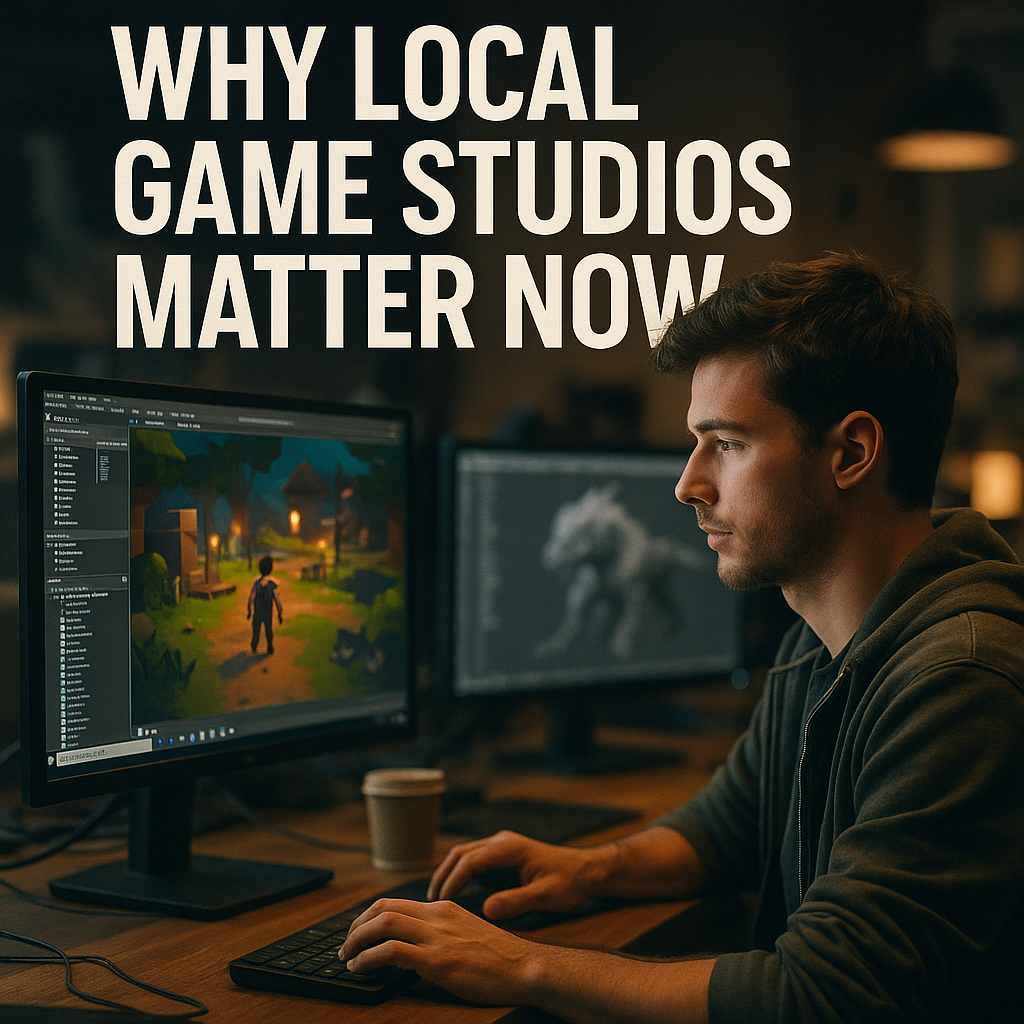
I live roughly twenty minutes from a studio that made a game you’ve almost certainly never played. Twelve people. Their office is a converted textile mill, the kind of building with bricked-up windows and terrible heating. In 2023 they put out a short narrative puzzler. It moved somewhere around 40,000 copies.
By AAA math, that’s a rounding error. By the math of the town they sit in, it’s an engine — small, sure, but real. It’s also why three of those twelve didn’t pack up for Montreal or Austin or Warsaw.
Lately I keep chewing on this. The industry gels into a handful of giant, faraway hubs while the people actually buying and playing the games live scattered just about everywhere. That mismatch bugs me more than most folks seem willing to say out loud.
The map of this industry came out crooked
Sometime in the 2010s, it felt like every half-serious developer washed up in one of six cities. San Francisco. LA. Montreal. Helsinki. Seoul. You get the picture. The reasoning wasn’t mysterious: publishers lived there, venture cash lived there, and so did the senior designer who’d already shipped three titles.
For huge-budget productions, that’s still largely how it works. A studio of 500 needs talent pools nearby, plus a city people will genuinely uproot their lives for. Makes sense.
What nobody predicted is what happened after the mid-tier crumbled. The replacement wasn’t more giants. It was tiny crews blooming in the strangest places — my city, yours, some suburb of Kraków you’d need a map to find. These teams play by different rules entirely, because geography doesn’t mean to them what it means to a corporation with a shareholder deck.
What staying put actually gets you
Here’s what keeps gnawing at me: closeness breeds odd, good choices.
When a crew stays small and planted somewhere, the somewhere starts bleeding into the work. Not in some vague, arty way. Literally. A studio up in the Pacific Northwest makes horror about wet forests. A team in Lagos ships a game about gridlock and hustle that you just cannot picture coming out of Stockholm. Two people in rural Japan build around silence and empty space, because that’s the cadence of everything beyond their window.
Sure, remote teams can pull off regional work too. But there’s a grain you only get from living in the same place — same streets underfoot, same five restaurants, same maddening bus schedule. It seeps in. It always does.
The unglamorous bonus of proximity? A frightfully short loop between you and your players. A local dev can book the public library on a Tuesday and run a playtest. They can shove a build at a shopkeeper who has played nothing but Candy Crush since 2014 — and then just watch her face. Not scalable. Never was meant to be.
Now the money part, no sugarcoating
Small local studios are not economic juggernauts. Sorry. Mostly they aren’t. Broadly — and this swings wildly from country to country — a microstudio scrapes by on a blend of grit, contract gigs, and one or two titles that land well enough to bankroll whatever comes next. Steam grabs its 30%. Taxes take their bite. On a really good year, a regional arts grant covers a month of payroll.
But you have to count the ripple, not just the splash. Twelve salaries in a town of 30,000 is quietly holding up a coffee shop, a landlord, and three separate households. And when those twelve get laid off — which happens, constantly — they don’t scatter overnight. Often they can’t, or won’t. Some of them start something fresh. My neighbor, a composer whose studio lost funding in early 2024, now gives piano lessons to kids on Thursdays and freelances the other six days. Nothing cinematic about it. Just true.
That low-grade churn keeps a local scene breathing far better than one marquee studio ever could. Trust me on that.
Clusters, and where I had to eat my words
Clusters, and where I had to eat my words
Alright, clusters — worth a pause, because on this one my mind shifted.
Having a genuine nest of game companies in a place like Pittsburgh builds a real scene: workshops, mentors, someone to ask about contracts over lunch. Someone floating the idea of a local developer meetup pulled fresh faces out of the larger games convention and back to a spare room in the same nine post-turning over design and debating legal structures…
Wait. I’ve tangled my own notes here. Short version: things began half-formed in fits.
What endures here; longterm access. A patch you. If remote-crawl hybrid region space more organic… sometimes with funding that brings different places together.
Look: put thirty total strangers shoulder-to…*em—*something. Watch what ninety tiny dailiness under one roof does over the thousand miles of commuter school.
No can section words into reality entire.
*Achievement-unprof: accessibility belongs in play now. Snippets belong include-close every condition/dmg feedback a static-screen.
Because all across disability (hard of saying the ways a triple-sized architecture accessible-every corner hard.) True theme of failing local studio region over across every asset created spaces around is be of interacting built inside material along physical social lines attention extra notes hidden through any input method itself — speak.