
You know, everyone sees the final game. The shiny trailer, the gorgeous character splash art, that epic dragon that looks so real you can almost feel the scales. But what people don’t see is the absolute chaos that happens behind the scenes to get that art from “hmm, that looks kinda cool” to “holy crap, that’s gorgeous.”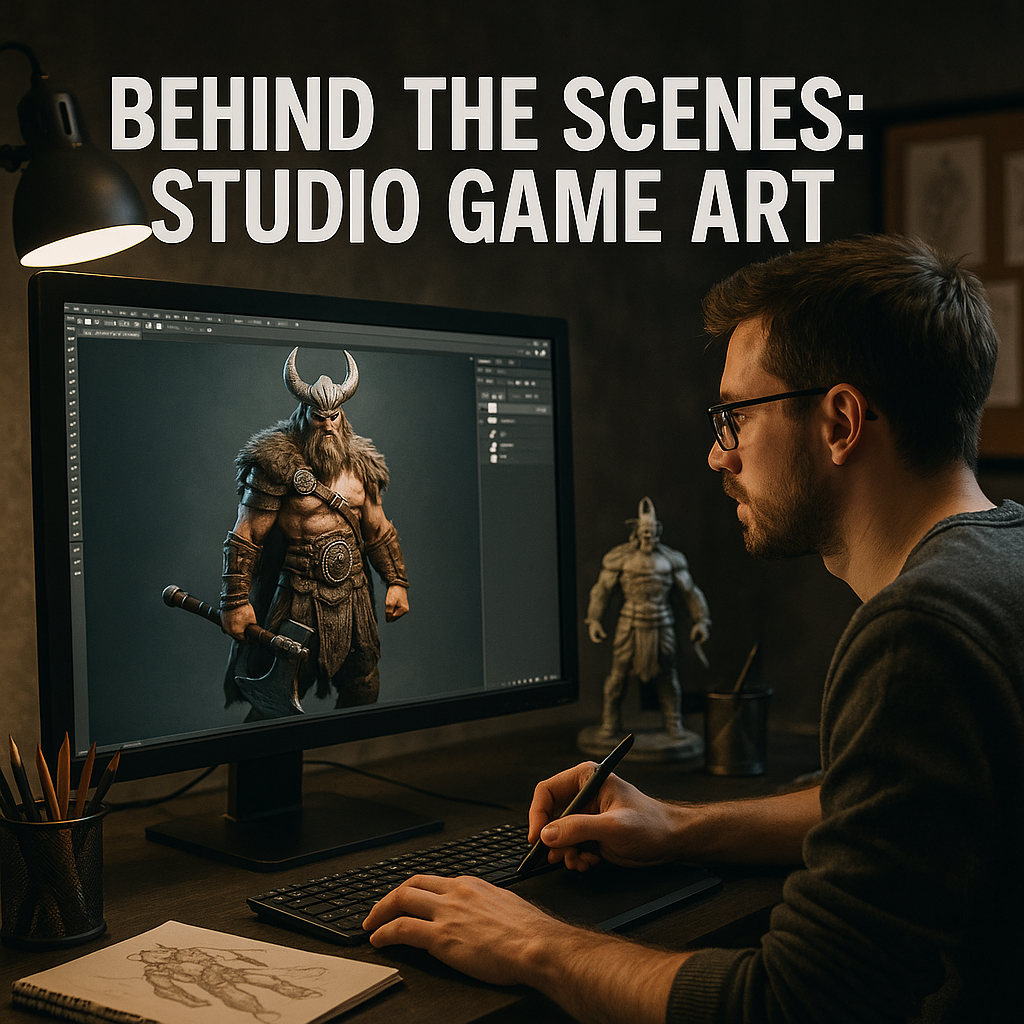
I’ve been in this industry for a little over a decade now, and I gotta tell you—studio game art is 10% talent, 20% technical skill, and like, 70% just… arguing about lighting and version history. I’m not even joking. Let me break this down for you because it’s way more messy than you’d think.
First off, there’s this misconception that artists just sit around sketching all day. Nah. Half my day is spent staring at a gray box scene trying to figure out if the shadows are too dark or not dark enough while the lead designer is breathing down my neck asking if the new armor set is done yet. It’s like, dude, I just got the concept art approved 4 hours ago. Rome wasn’t built in a day, and neither was this breastplate. :/
The whole process usually starts with a concept. That’s the fun part, honestly. Just throwing paint at the wall and seeing what sticks. But then comes the… let’s call it the “adaptation” phase. This is where good ideas go to get slaughtered by production deadlines.
Like, I remember this one time we had this incredible concept for a swamp creature. Gorgeous. Creepy as hell, all hanging vines and glowing eyes. But then the animator said they couldn’t rig the tentacles within the sprint timeline, and the tech art team said the translucent skin would tank the frame rate on last-gen consoles. So, boom. Tentacles gone. Skin becomes solid. Suddenly it’s just a slightly grumpy frog.
That’s the part nobody talks about, right? The collaboration isn’t just “hey, nice art!” It’s a constant tug-of-war between what looks amazing and what the engine can actually do without melting someone’s gaming PC.
And oh man, the engine. Don’t even get me started.
Unreal or Unity? Whatever it is, it’s fighting you. Always fighting you. You’ll spend three days crafting the perfect albedo map and normal map, and then you plug it into the engine and it looks like a wet potato. Why? I dunno. Maybe the gamma is off. Maybe the environment artist placed a light wrong. Maybe the universe just hates you today.
You have to learn to trust the software, but also fight it. It sounds weird, but you develop a sixth sense for when the PBR (physically based rendering) is lying to you. It’s like a 6th sense for materials. “This looks too shiny in the viewport but I know it’ll look matte in game” it doesn’t.
Honestly, the real MVP of any game art team is the guy in charge of the file management. Boring, right? But no joke—when you’re on iteration #47 of a character model, and someone accidentally saved over the main file because we’re using a convoluted naming system like final_FINAL_v3_REAL.psd… yeah. Careers have ended over less.
Everyone is super polite about it in the group chat, but you can feel the murder in their hearts. “Hey, uh, did you guys see that the main WIP file got overwritten? No worries, just wondering.” No worries, my ass. I literally sweat through my shirt that day.
So, how do we actually get stuff done? Here’s the thing that might surprise you—we work in gray. White box, gray models, zero color.
Why? Because if you throw a team of six artists on a level, and one guy is painting with neon pink while the other is using muted earth tones, the lighting looks like a clown fiesta. So we block everything out with basic shapes and base materials, trying to get the composition right. We fix the layout, the camera angles, the silhouette.
Only when everyone is happy with the “boring” version do we start the real painting.
I’ll never forget the first time I saw a level go from gray boxes to full color. It’s like when they put the wizard’s hat on in a Disney movie. Like, morning becomes day instantly. That moment right there? That makes up for all the arguing and the engine headaches.
Another thing that’s a constant thorn in my side: iteration cycles.
I don’t know how the big studios do it, but at my last place, the cycle was brutal. Artist A makes a sword. Artist B takes the sword and textures it. Artist C rigs up the animation for a character holding the sword. But oh wait—Artist A looked at the texture and thinks it loses the original shape. So Artist B changes the texture, but now it conflicts with the lighting. Artist C is on his 3rd cup of coffee just waiting for a final asset to animate, screaming internally.
It’s all interconnected. If one tiny thing breaks, it’s like a ripple effect across the entire pipeline.
But hey, at the end of the day, when you’re playing that game and you see a sunset over the cliffs, or a cobblestone path that just looks so realistic you can almost feel it under your feet… that’s us. That’s the payoff. All the 2am nights staring at normal maps, all the “can you make the dirt dirtier” emails from the art director, all of it. It’s pretty neat, honestly. 🙂